
A border region, and it shows
One million two hundred thousand people, four provinces and three languages meeting within a hundred and fifty kilometres.
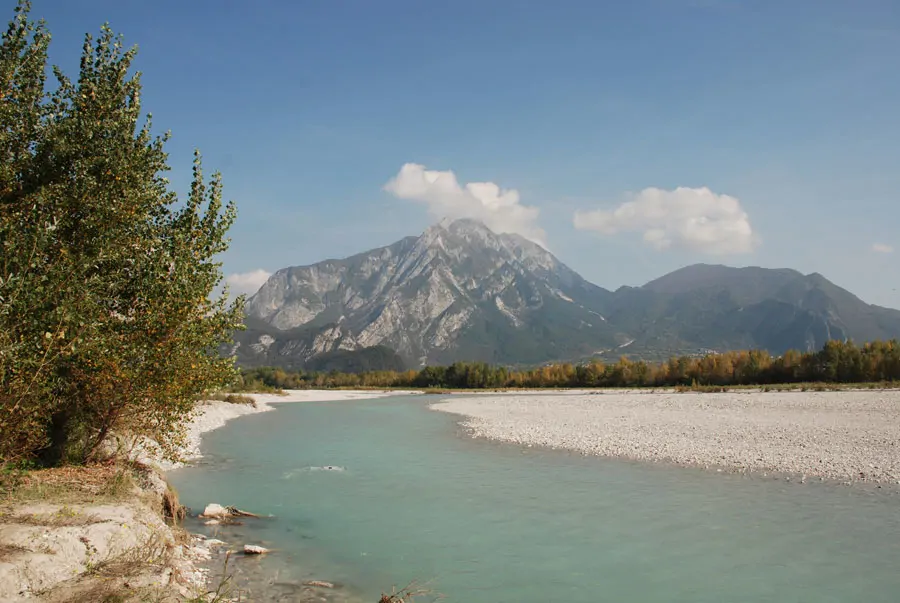
Here Italy ends and something else begins. Friuli Venezia Giulia sits in the corner where the alpine arc bends east and the Po plain runs out into the gulf, and that is why it holds things that elsewhere lie seven hundred kilometres apart. In a single day you go from the sand of Lignano to the walls of Montasio, and along the way you hear Italian, Friulian and Slovene.
Four different pieces
The coast comes in two kinds: from Lignano to Grado it is low sand and lagoon, from Duino to Muggia it is limestone cliff and the sea goes deep at once. Behind lies the plain, which to the north fills with gravel carried down by the torrents and to the south becomes a land of water, of resurgent springs. Higher up are the hills of the Collio and the Colli Orientali, and beyond them the Alps: Carnic to the west, Julian to the east.
Where the campsites are
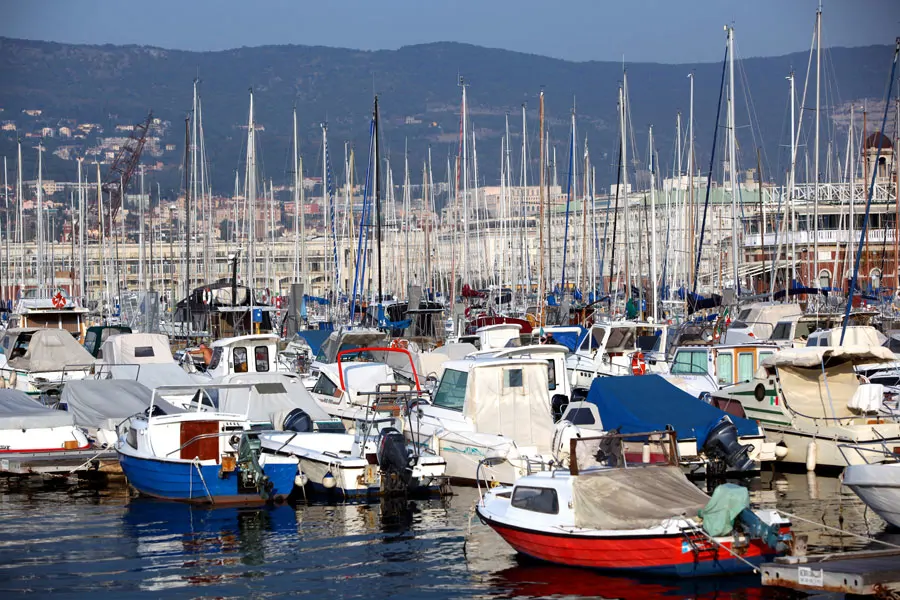
Nearly all between Lignano and Grado, and they are proper villages: pine woods, pools, entertainment, direct access to the sand. Lignano is larger and livelier, Grado is an island and quieter. In the mountains around Tarvisio a few stay open all year, with the peculiarity that in winter they serve skiers. In between, on the plain and on the Carso, they are rare.
Morning on the beach, afternoon in the mountains. Here that is not a figure of speech.
What the campsite managers in Lignano say
How to plan it
You choose a base on the coast and travel out from there, because the distances are short: Udine is fifty kilometres from Lignano, Trieste ninety from Grado, Tarvisio a hundred and forty. Slovenia and Austria are an hour away too, and the border is no longer visible.
The one thing worth knowing is the bora. It blows mainly in winter and mainly on the Carso, and when it really arrives it moves things: a badly pitched tent, for instance. On the sandy coast west of the Isonzo it is felt far less.